
Why is implicit bias important?
As health care and service professionals and organizations work to provide care to a diverse population, many are recognizing the need to address implicit bias. All people have implicit bias, also called unconscious bias. These positive or negative attitudes or stereotypes affect our understanding, actions, and decisions in an unconscious way. In health care, this can result in inequitable care.
The first step in addressing implicit bias is acknowledging that it exists. The resources in this section will assist individuals and organizations:
Understand the Impact of Bias in Health Care
Numerous studies show that health care professionals are prone to engaging implicit biases, which can impact provider-patient interactions. Clinicians may provide the same information on treatment choices, risks, and outcomes, but nonverbal cues may counter efforts to display empathy or build rapport. Studies have shown that patient behavior, and decisions are affected when they perceive bias from their clinicians. Bias can change a patient’s behavior resulting in higher treatment dropout, lower participation in screening, delays in filling prescriptions, poorer perception of care quality, avoidance of health care, and ultimately, worse health outcomes. Explore the resources below to learn more about the effects of bias on health care outcomes.
 How Does Implicit Bias Affect Health Care?
This short video from the Institute for Healthcare Improvement describes the ways implicit bias appears in health care. (3-minute video)
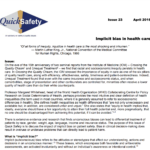 Implicit bias in health care
This Quick Safety article from The Joint Commission discusses the negative impact of implicit bias on health care outcomes. (4-page PDF)
 Kirwan Institute for the Study of Race and Ethnicity
This website contains original research and reports on how structural racialization and implicit bias create and sustain barriers to opportunity and health. Kirwan is an interdisciplinary engaged research institute at The Ohio State University. (Website)
Assess and Address Biases
Bias can manifest in a variety of ways in health care. For example:
- Spending less time touching certain patients
- Looking at the nurse or computer instead of the patient
- Crossing arms or keeping hands in pockets
- Standing further away from the bedside of certain patients
- Using first-person plural pronouns like “we,” “ours” or “us” (e.g., “We are going to take our medicine, right?” when interacting with Black patients, which can suggest lack of responsibility or will to control health)
- Talking more to exert control over a patient or voice expertise, instead of listening more and validating an individual’s health or experience
Some biases we are aware of, and others are unconscious. Explore the resources below to get a better understanding of your own unconscious biases. Then use the knowledge you’ve gained to identify action steps to mitigate bias and the resulting negative effect on patients.
 Implicit Bias in Health Care Quiz
This 10-question quiz from Stratis Health reveals how implicit bias affects patient care and provides practical tips to help correct bias and provide the best care possible. You can also use this to catalyze discussion with colleagues. (Online quiz)
 The Minnesota Dignity in Pregnancy and Childbirth Project
This online training is designed to help health care professionals deepen their understanding of the impact of structural racism on the health and health care of Black and Indigenous birthing people. (eLearning course)
 Project Implicit Social Attitudes Tests
Take any number of implicit association tests to discover your automatic preferences for different groups of people. (Website)
 Intercultural Development Inventory
The IDI assesses intercultural competence – the capability to shift cultural perspective and appropriately adapt behavior to cultural differences and commonalities. (Website)
What is Bias and What can Medical Professional Do About it?
This short video from the Institute for Healthcare Improvement explains how health care providers can stop implicit bias from negatively impacting patients. (5-minute video)
Stratis Health can help put an end to unconscious bias in health care practices. Contact Sue Severson (sseverson@stratishealth.org) to learn more.
Assess and Address Organizational Biases through CLAS
The Culturally and Linguistically Appropriate Services (CLAS) Standards are a framework developed by the Office of Minority Health to improve health care quality and advance health equity within health care organizations.
 The National CLAS Standards
Learn more about the National CLAS Standards developed by the Office of Minority Health to serve as a framework for organizations to improve health care quality and advance health equity. (Website)
 Why culturally and linguistically appropriate services (CLAS) matter
This short video from the Office of Minority Health shares perspectives from CLAS champions about why CLAS matters. (7-minute video)
Engage Stratis Health in an organization-wide CLAS assessment to help you fully understand how well your organization is performing in relation to the CLAS Standards. Contact Sue Severson (sseverson@stratishealth.org) to learn more or request a proposal.
Engage in Continuous Learning
Keep yourself informed. Start a consciousness-raising group with your colleagues to stay current on the latest regarding health equity, disparities, anti-racism work, and related topics, then discuss as a group and identify opportunities to incorporate what you learn into your work.
Follow these thought leaders on Instagram
Listen and subscribe wherever you get your podcasts
Read or listen to books by thought leaders
- How to Be an Antiracist – Ibram X. Kendi
- Black Man in a White Coat: A Doctor’s Reflections on Race and Medicine – Damon Tweedy, M.D.
- Medical Apartheid – Harriet A. Washington
- White Fragility – Robin DiAngelo
- Caste: The Origins of Our Discontents – Isabel Wilkerson
- The Color of Compromise – Jemar Tisby
- Hood Feminism – Mikki Kendall
- American Like Me – American Ferrara
- How the Garcia Girls Lost Their Accents – Julia Alvarez
